
Quick experiment. Two scenarios.
Scenario one: you buy yourself a fancy coffee, the one with the oat milk and the caramel drizzle. It costs six dollars. You feel good for about eleven minutes.
Scenario two: you’re in line behind someone who’s short two dollars for their groceries, and you cover it. It costs two dollars. You feel good for the rest of the day — maybe the rest of the week.
It makes no financial sense — but perfect psychological sense. Helping a stranger genuinely feels better than treating yourself, and science knows why.
The Giver’s High Is Real Chemistry
This isn’t just a nice feeling people made up to sell charity calendars. When you help someone, your brain releases a cocktail of feel-good chemicals — endorphins, dopamine, and oxytocin — that researchers have nicknamed the giver’s high.
Brain scans show giving activates the same reward regions as food and money — your brain files both “I got something good” and “I did something good” under reward.
But giving has a bonus that buying yourself a latte doesn’t: the oxytocin. That’s the bonding hormone, the same one that surges when you hug someone you love. Treating yourself is a solo transaction. Helping someone is a connection — and your brain rewards connection more richly than consumption.
Why Small Beats Grand
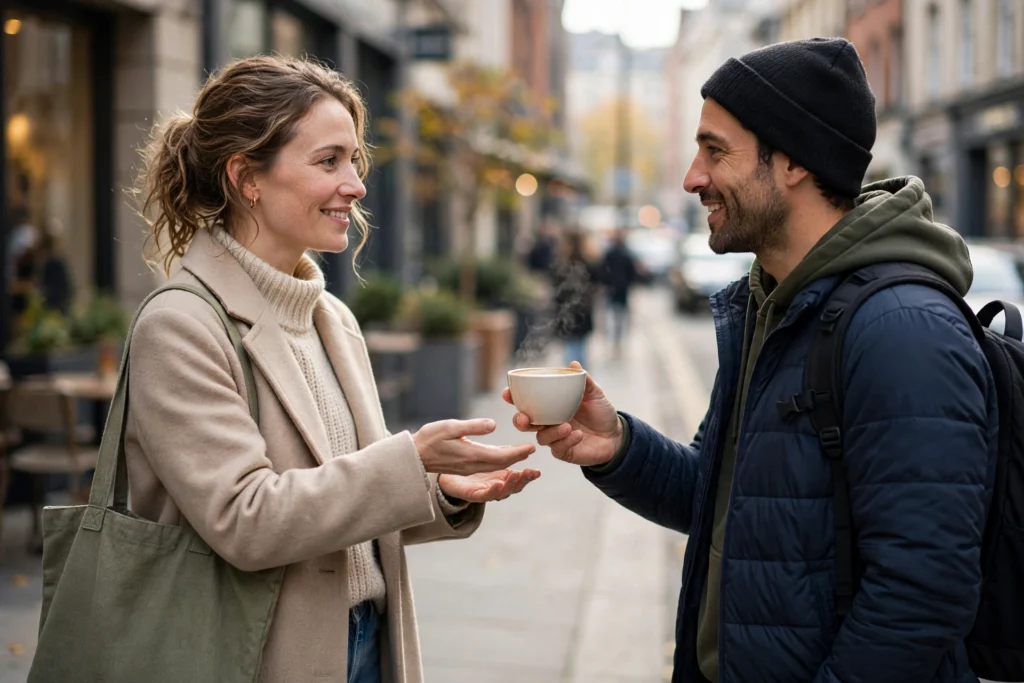
Now here’s where most of us get generosity wrong. We think it has to be big to count: the charity gala, the five-figure donation, the volunteer trip abroad. Because the bar feels so high, we do nothing on ordinary Tuesdays.
But the research tells a different story. Small, spontaneous acts — holding a door, giving up your seat, helping someone carry a stroller up the stairs — deliver a surprisingly large happiness boost relative to their cost. One study found that people who performed small kind acts for others reported bigger mood lifts than people who spent the same amount of money on themselves.
Why? Because small acts are surprising — to you and to them. A grand gesture is planned; your brain has already processed it. A spontaneous kindness catches your own reward system off guard, and the delight of the other person is fresh and unscripted. You get to witness the exact moment someone’s day gets better. That’s a front-row seat your brain doesn’t forget.
The Comparison Trap of Treating Yourself
There’s another reason self-treats underperform: they’re haunted by comparison. That fancy coffee? Within an hour you’ve forgotten it, because pleasure adapts fast. Psychologists call this the hedonic treadmill — the good feeling of a purchase fades, and you need a slightly better one next time to get the same hit.
Kindness doesn’t have a treadmill. Helping a stranger doesn’t get old because every situation is different, every person’s gratitude is different, and — crucially — you can’t compare your kindness to someone else’s fancier kindness the way you compare phones or cars. There’s no “kindness influencer” making you feel your good deed wasn’t aesthetic enough.
The Secret Second Effect
Here’s the part researchers find most moving: helping strangers doesn’t just make you happier in the moment. It changes how you see people.
After a week of small kind acts, people consistently report that strangers seem friendlier, the world seems safer, and their own neighborhood feels more like home. Psychologists call this the benevolence effect: acting kindly rewires your assumptions about others. You start expecting goodwill because you’ve been producing it.
Think about what that means. The loneliest feeling in modern life is the sense that everyone’s a stranger and nobody cares. A few dollars at a grocery checkout, a few minutes helping someone jump their car — and suddenly the strangers aren’t quite strangers anymore.
How to Build It Into Your Week
You don’t need a volunteer schedule or a cause. You need a habit of noticing. Try these:
- The weekly one: Do one deliberate kind thing for a stranger every week. Pay for the coffee behind you. Leave a big tip with a kind note. Return a lost item instead of walking past it.
- The daily micro: Hold doors. Let someone merge in traffic. Compliment a coworker’s work to their face. These take seconds and your brain counts every one.
- The attention game: Once a day, look for someone who looks like they’re struggling — the person juggling bags, the confused tourist, the overwhelmed parent. Noticing is the whole skill. The helping part is easy once you see it.
None of this requires money, time, or sainthood. It requires the smallest possible shift: from moving through the world on autopilot to moving through it with your eyes open.
Practical Takeaways
- Helping others triggers the same brain reward regions as receiving pleasure — plus a bonus hit of the bonding hormone oxytocin.
- Small, spontaneous kind acts deliver a bigger happiness boost than spending the same money on yourself.
- Self-treats fade fast thanks to the hedonic treadmill; kindness doesn’t, because every act is unique and incomparable.
- Regular small kindnesses rewire how you see people — strangers start feeling friendlier and the world safer.
- You don’t need grand gestures: one deliberate kind act a week plus daily micro-kindnesses is enough to feel the effect.
- The whole skill is noticing — look for one struggling person a day, and the helping part takes care of itself.