
It’s been dry for weeks. Dust on the windowsills, the garden holding its breath. Then, one afternoon, the light changes — and before a single drop falls, you smell it. That rich, earthy, almost electric scent rising off the pavement.
And something in your chest unclenches. Your shoulders drop. For no reason you can name, the world feels fresh — like everything just got a second chance.
You’re not imagining it. That smell has a name (well, two of them), a chemistry, and a very old reason for making you feel the way you do.
What’s Actually in That Smell
The classic “smell of rain” has a proper scientific name: petrichor. A pair of Australian researchers coined it in the 1960s, from Greek words meaning roughly “the blood of stones.” Dramatic? Slightly. Wrong? Not at all.
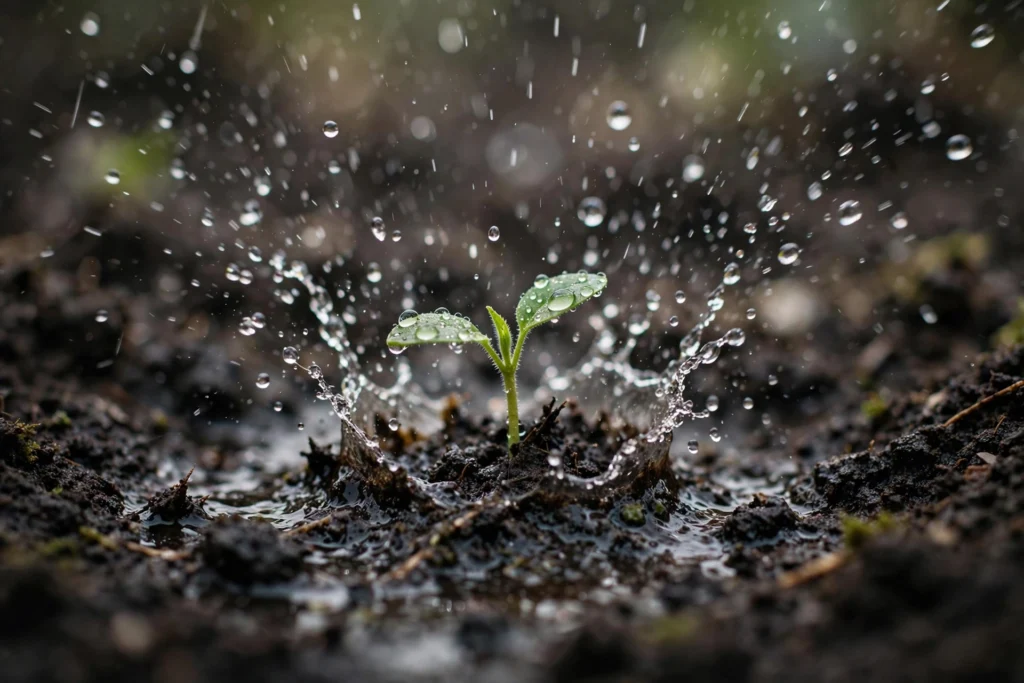
Here’s the recipe. During dry weather, certain soil bacteria — especially a group called Streptomyces — produce a compound called geosmin as they grow. Plant oils accumulate in the soil too. Then rain hits: the drops trap tiny air bubbles as they strike the ground, and when those bubbles burst upward, they launch microscopic particles of geosmin and oils into the air. Your nose does the rest.
There’s often a second note in the mix: ozone. Lightning splits oxygen molecules, which reform into ozone, and downdrafts from a storm carry that sharp, clean, almost metallic scent down to nose level. That’s why rain sometimes smells “electric” before it smells earthy.
Three ingredients — bacteria, plants, lightning — and your brain reads the combination as relief. Which brings us to the stranger question.
Why Your Nose Is Absurdly Good at It
Humans can detect geosmin at concentrations of a few parts per trillion. To put that in perspective: if you could smell a teaspoon of geosmin dissolved in a few hundred Olympic swimming pools, you’d still catch it. We are, by mammalian standards, mediocre smellers — yet for this one compound, we’re world-class.
Evolutionary biologists have a strong hunch about why. For most of human history, and for all of our ancestors’ history, finding water was the difference between a good season and a dead camp. An animal that could smell rain coming — literally smell it on the wind before it arrived — could follow it. Some researchers think our extreme sensitivity to geosmin is a fossil of that survival skill: a rain-detector wired straight into the oldest parts of the brain.
Camels and desert animals show the same trick, following petrichor to distant oases. We may have traded the nomadic life for apartments, but the wiring stayed. Your nose still reports to the part of you that survived by finding water.
The Mood Reset Is Real (and It’s Mostly Memory)
So the chemistry explains the smell. But why does it feel like an emotional reset — like exhaling after holding your breath?
Partly, it’s the oldest conditioning in the book. Rain means the heat breaks. It means the dust settles, the air cools, plants perk up. For a creature that evolved under the sun, rain arriving is the environment saying: the hard part is over. Your nervous system seems to have kept that memo even if you’ve never farmed a day in your life.
The rest is personal. Smell is the sense most directly wired to memory — the olfactory bulb plugs straight into the brain’s emotion and memory centers, bypassing the usual checkpoints. So the smell of rain doesn’t just smell like rain; it smells like your rain. Summer storms at your grandmother’s house. The first rain after a brutal heatwave. That camping trip where everyone huddled under the tarp laughing. The scent arrives and drags a whole slideshow of relief-moments along with it.
That’s also why nobody agrees on whether it smells “good.” Ask ten people and you’ll get ten memories wearing the same perfume. The chemistry is identical; the feeling is autobiographical.
Why You Can Never Quite Bottle It
People have tried, of course. Perfumers have been chasing petrichor for decades, and “rain” candles and sprays are a whole industry. They’re never quite right — close enough to recognize, wrong enough to disappoint.
Two reasons. First, the real thing is a sequence: the dry-earth geosmin first, then the ozone snap, then the wet-concrete fade as the storm passes. A bottle gives you one frozen chord; nature plays the whole progression. Second, context does half the work. The smell hits different when the temperature drops ten degrees, the light goes silver, and the first fat drops smack the pavement. Your brain doesn’t just smell rain — it smells the whole scene, and it files the feeling under that, not under a jar.
There’s also a cruel little twist: the smell fades fast. Within minutes of steady rain, your nose adapts and the magic dulls. Psychologists call this hedonic adaptation — the brain’s habit of turning down the volume on anything constant. The reset feeling is, by design, a transition feeling. It’s the arrival that moves you, not the staying.
Practical Takeaways
- The smell of rain (petrichor) is mostly geosmin from soil bacteria plus plant oils, launched into the air when raindrops burst on dry ground — with a sharp note of ozone when lightning is involved.
- Humans detect geosmin at parts-per-trillion levels, likely an evolved rain-finding ability from when locating water meant survival — your nose is still running ancient software.
- The emotional “reset” comes from deep conditioning (rain = relief from heat and drought) plus smell’s direct line to memory: it smells like your past rainy days.
- Perfume and candles never quite nail it because the real thing is a sequence — dry earth, electric snap, wet fade — plus the temperature drop, the light change, the sound.
- The feeling fades within minutes of steady rain thanks to hedonic adaptation; it’s the arrival that moves you, which is why the first smell of a storm is always the best one.
- Next time it hits, pause for ten seconds and actually notice it — it’s one of the few free, universal mood-lifters that requires absolutely nothing from you.