
Last Tuesday, on a walk you’ve taken four hundred times, you found a single blue jay feather lying perfectly in the middle of the sidewalk. Not near a tree. Not near a nest. Just there — impossibly blue, impossibly placed, like someone left it for you specifically.
You picked it up. You carried it home. It’s on your desk right now.
Why does something so small feel so significant? Because your brain is a discovery machine, and it just got fed.
The Treasure-Hunter Wiring
Humans are wired to notice the novel. Deep in the brain, the dopamine system — the same one behind motivation and pleasure — fires not just for rewards, but for novelty itself. New information, unexpected patterns, things that break the routine: your brain treats all of them as tiny jackpots.
This made sense on the savanna, where noticing the unusual meant food or danger. The wiring never got the memo that we moved to the suburbs. So when you spot a mushroom growing out of a tree stump in a shape like a tiny staircase, or a lost glove arranged neatly on a fence post, your ancient treasure-hunter circuitry lights up like a slot machine.
The feather on the sidewalk isn’t just a feather. It’s your brain doing what it evolved to do, and doing it well.
Attention Turns Routine Into Adventure
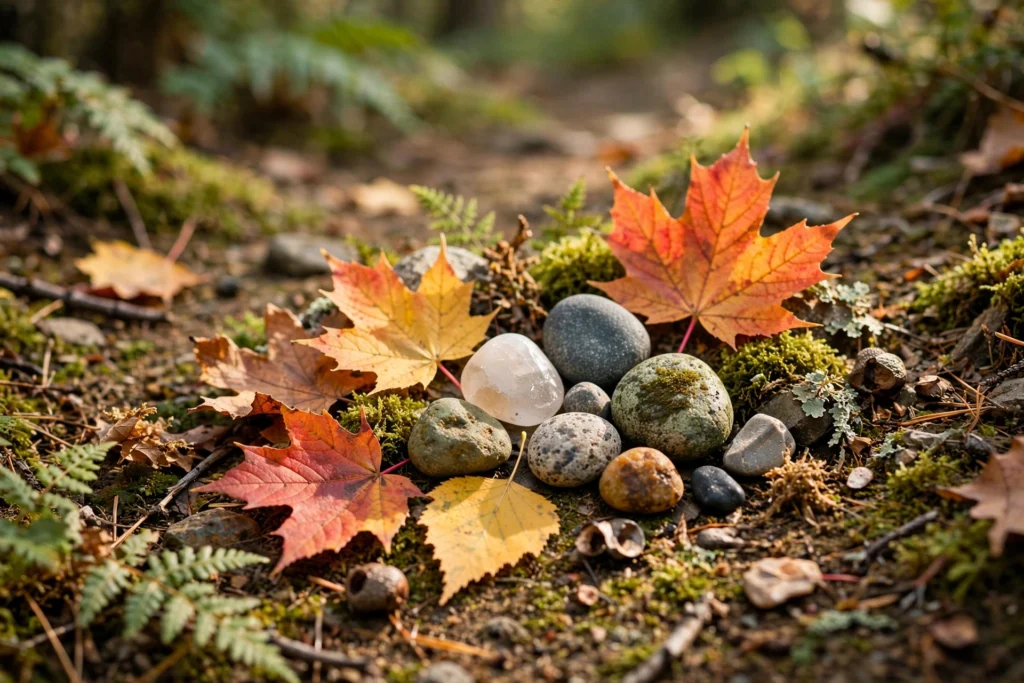
Here’s the remarkable part: the strange things were always there. The walk didn’t change. You did — or rather, your attention did.
Psychologists distinguish between two modes of seeing: navigational and exploratory. Most of the time, we’re navigational. We walk to get somewhere, eyes on the path, mind on the grocery list. The world becomes background — a blur between origin and destination.
But sometimes we slip into exploratory mode — the light is different, we’re phoneless for once — and the familiar route reveals a museum of oddities: the never-registered door color, the garden gnome in a tiny raincoat, the pavement crack shaped like Florida.
Nothing changed except the aperture of your attention. The adventure was there all along, waiting for you to look down.
A Field Guide to Ordinary Wonders
Once you start looking, a single ordinary walk holds astonishing inventory:
- Feathers — each one a small miracle of engineering, each color a story about the bird that dropped it.
- Fungi — mushrooms appear overnight in shapes that look designed by a whimsical architect: shelves, cups, coral, brains.
- Lost objects with implied stories — a single child’s shoe (where’s the other one? what happened?), a love letter’s envelope, a key that opens something, somewhere.
- Nature’s graffiti — lichen spelling patterns on rocks, frost forming ferns on windows, roots cracking concrete with slow, unstoppable patience.
- Human traces — chalk drawings fading in rain, a painted rock hidden for strangers to find, footprints that tell you who passed before you.
None of these are rare. They’re just rarely seen.
Why It Feels Like a Gift
These discoveries carry a specific flavor — delight mixed with something like gratitude. Researchers note that unexpected natural finds trigger a mild version of the awe response to grand vistas: a sense of something larger than your to-do list.
Part of it is the unearned quality — you didn’t plan the feather or earn the mushroom. In a life where every good thing requires effort and payment, a free strange discovery feels like the universe winking at you.
Then there’s the story instinct: how did this get here? Who lost it? Your brain can’t resist completing the narrative — turning a walk into a tiny mystery, solved or unsolved.
How to Walk Like an Explorer
You can’t force discoveries, but you can dramatically raise the odds:
- Vary the route slightly. Even one different turn per week exposes you to new territory. Novelty lives at the edges of routine.
- Look down, then up, then sideways. We default to eye-level forward. The feather was on the ground; the hawk is in the sky; the weird carving is on the wall you always pass.
- Walk phoneless sometimes — a screen fills the exact attentional space where discoveries land.
- Bring a pocket for treasures. Giving yourself permission to collect — a feather, a strange stone, a photo of the mushroom — tells your brain that noticing is the point.
- Walk the same route in different weather. Rain, snow, golden-hour light, and fog each reveal a different version of the same street. Familiarity is just one weather pattern deep.
The walk you’ve taken four hundred times has a four-hundred-and-first version waiting. It’s weirder than you think.
Practical Takeaways
- Your brain’s dopamine system fires for novelty itself — spotting something unusual on a walk is a genuine neurochemical reward.
- Most walks happen in navigational mode (eyes on destination); slipping into exploratory mode reveals the oddities that were always there.
- Ordinary routes are full of wonders: feathers, fungi, lost objects with implied stories, nature’s patterns, and human traces.
- Unexpected discoveries feel gift-like because they’re unearned — a free moment of wonder in a life where everything else requires effort.
- Raise your odds by varying routes slightly, looking in all directions, walking phoneless sometimes, and revisiting familiar paths in different weather.
- The strange things were never rare — they were just rarely seen. Attention is the only equipment you need.