
Every October, millions of otherwise sensible adults voluntarily pay money to be terrified. They stand in line — sometimes for hours — to walk through dark hallways where strangers in masks jump out screaming. They sit in theaters watching fictional people make catastrophically bad decisions in haunted houses. They decorate their own front yards with skeletons.
By survival logic, this is absurd — fear exists to keep us alive, and paying to feel it is like paying to touch a hot stove. Yet haunted houses are a billion-dollar industry and October turns neighborhoods into voluntary fright zones.
So what are we actually buying?
Benign Masochism: Enjoying the Bad Feeling
Psychologists have a wonderful term for this: benign masochism — the enjoyment of experiences that feel bad but that we know are safe. It’s the same mechanism behind eating painfully spicy food, riding roller coasters, and crying at sad movies. Your brain gets the full physiological thrill — pounding heart, adrenaline surge, heightened senses — while a deeper part of your mind holds up a sign that says: relax, this isn’t real.
That gap between feeling and knowing is where the pleasure lives. Real fear is rare in modern life — our ancestors got adrenaline from predators; we get ours from a guy named Kevin in a zombie costume.
The haunted house is essentially a gym for your threat-response system — a place to run the machinery at full power with zero actual risk.
The Afterglow Effect
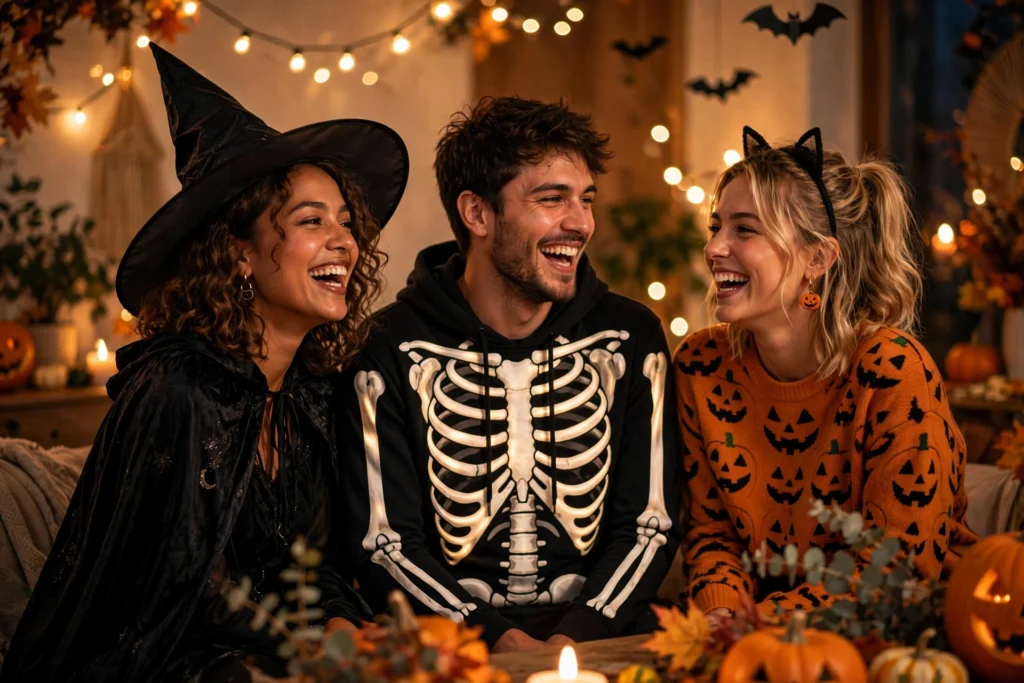
Here’s the part that keeps people coming back: the fear is only half the product. The other half is what happens after.
When a scare ends, your brain overshoots into relief — heart rate drops, muscles unclench, calm washes over you deeper than before. Researchers call this the excitation transfer effect: the arousal from fear gets reinterpreted by your brain as exhilaration once the threat passes.
That’s why people come out of haunted houses laughing, buzzing, hugging each other. They didn’t just survive something scary. They got the neurochemical reward of surviving something scary, which is arguably better — all of the triumph, none of the trauma.
It’s also why horror movies are best watched together: the shared gasp, the collective scream, the nervous laughter afterward bonds people faster than almost anything else.
Safe Fear Bonds People
Think about it: what’s the fastest way to feel close to a stranger? Survive something together. Soldiers, disaster survivors, sports teams — shared intensity forges connection. A haunted house compresses that dynamic into twenty minutes for the price of a ticket.
Couples figured this out long ago — hence horror-movie date night. The racing heart from the scare gets slightly misattributed to the person next to you. Psychologists demonstrated this decades ago: arousal from one source (fear) can amplify feelings from another (attraction). Your brain isn’t great at labeling why your heart is pounding. It just knows it’s pounding next to them.
Friend groups do the same thing. The shared scream becomes a shared story, retold for years: “remember when Marcus actually cried in the clown room?” Fear, survived together, becomes folklore. And folklore is just friendship with a longer memory.
October Gives Fear a Container
But why October specifically? Why does this all concentrate into one month?
Part of it is tradition, obviously — Halloween’s roots tangle through ancient harvest festivals and old beliefs about the boundary between worlds growing thin. But the modern version serves a psychological function those old festivals would recognize: containment.
Life is full of unmanageable fears — illness, money, mortality. You can’t schedule those. Halloween offers the opposite: fear with edges. It starts at 7 p.m., ends at 10, costs twenty dollars, and the monsters clock out and go home. In a world of ambient anxiety, there’s profound relief in a fear you can put in a box — literally walk into it, and walk back out.
October is the month we collectively agree to take fear out of the shadows, dress it up, charge admission, and laugh at it together. It’s not denial. It’s defiance.
The Line We Don’t Cross
There’s a line, and we all sense it: we love haunted houses but not real danger, horror movies but not real suffering. The enjoyment depends entirely on the safety frame.
That tells you what we’re really after. We don’t want to be afraid. We want to practice being afraid — to prove to ourselves that we can feel the full force of fear and come out the other side laughing. Every October, millions of people run that drill. And every November, they walk around feeling, just slightly, braver than before.
Not a bad return on a twenty-dollar ticket.
Practical Takeaways
- We enjoy scary experiences through benign masochism: the brain loves the full thrill of fear while knowing it’s safe.
- The real payoff is the afterglow — relief after a scare overshoots into exhilaration, which is why people exit haunted houses laughing.
- Shared fear bonds people fast: couples, friends, and even strangers feel closer after surviving a scare together.
- A racing heart from fright can amplify attraction and connection — your brain misattributes the arousal to the person beside you.
- Halloween works because it gives fear a container: scheduled, ticketed, and escapable, unlike the real anxieties of life.
- Underneath it all, we’re practicing bravery — proving we can feel fear fully and walk out laughing.