
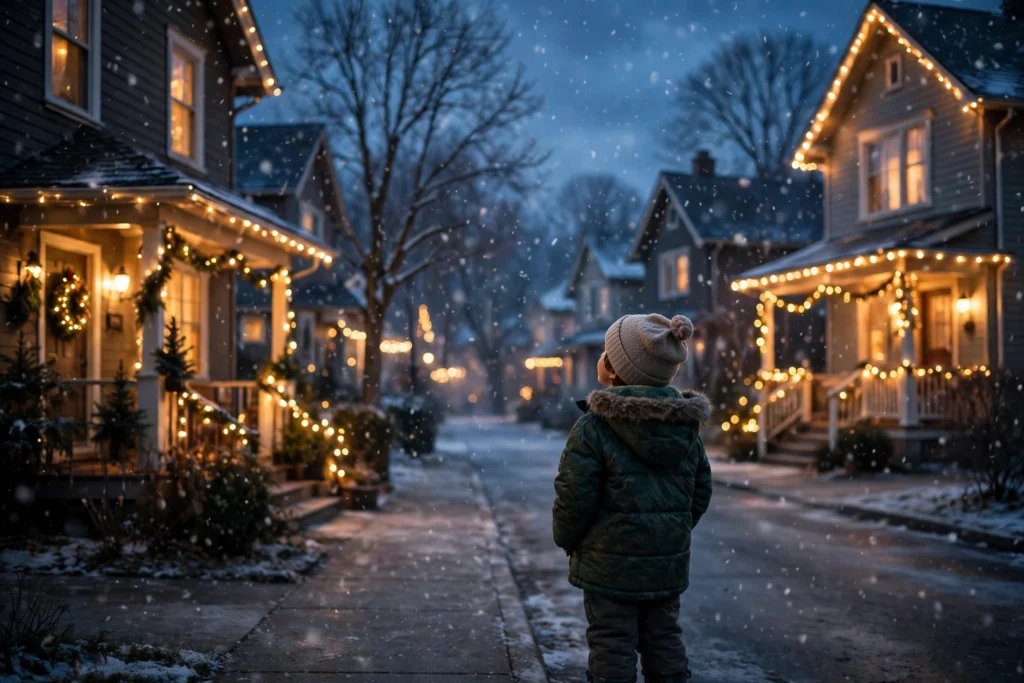
You can be forty-three years old, carrying groceries through a parking lot, mentally reviewing tomorrow’s dentist appointment — and then you turn a corner, see a house absolutely buried in twinkle lights, and something in your chest goes oh. Not a thought. A feeling. The same one you had at seven, in footie pajamas, staring at the tree while the rest of the house slept.
You are not being sentimental. You are being neurological. Christmas lights push a remarkable number of your brain’s oldest buttons at once.
Lights Hit the Brain’s Oldest Doorway
Your brain processes visual information through two main routes: the slow, careful one that reads spreadsheets, and the fast, emotional one that decides whether something is wonderful before you have finished blinking. Colored lights skip the spreadsheet entirely.
Warm light in the middle of winter darkness is one of the oldest safety signals your species knows. For most of human history, darkness meant danger and cold, and a warm glowing light meant shelter, people, and food. Your nervous system never got the memo that times changed. When a whole street lights up against a black December sky, your body reads it as we are safe, we are together — and it relaxes accordingly.
Nostalgia Is a Time Machine With Mood Lighting

The feeling you get is not just about the lights in front of you. It is about the lights behind you.
Psychologists call this autobiographical memory, and memories wrapped in strong sensory detail get stored in extra-high resolution. Your childhood Decembers were almost certainly the most visually spectacular weeks of your young life: the tree, the street decorations, the candles, the glow through other people’s windows. No other time of year looked like that, so your brain filed those memories under uniquely glowing.
Every December since, new lights reopen the old files. This is why a string of cheap bulbs can move you more than a fireworks show: the bulbs come with twenty years of accumulated Decembers attached. You are reacting to every display at once, including the one from when you were seven.
There is a reason nostalgia research consistently shows this backward glance makes people feel warmer, more connected, and more optimistic about the future. It is not wallowing. It is your brain reminding you of evidence that joy has happened before and can happen again.
Winter Needs a Counterweight
December asks a lot of your mood. The sun clocks out at 4 p.m., the cold keeps you indoors, and your serotonin is running on fumes. Seasonal slumps are real, and they are biochemical, not character flaws.
Light is one of the most direct mood levers your brain has. Bright-light therapy is an actual treatment for winter low mood because light hitting the retina tells the brain to adjust its chemistry — more alertness, steadier energy, better sleep timing. Christmas lights are not therapy, but they rhyme with it: thousands of tiny bright points, everywhere you look, for weeks.
Lights Give Adults Permission to Play
Here is the part nobody talks about: grown-ups are not supposed to gawk. We are supposed to have seen it all, to be unimpressed, to keep walking. Christmas lights quietly revoke that rule.
A street of wild, over-the-top decorations is a socially approved zone of silliness. You are allowed to slow the car down, to take the long way home just to see that one house, to gasp. Children live in this state naturally — everything is worth staring at — and for about six weeks a year, lights hand that state back to the rest of us.
Shared Glow, Shared Feeling
The best light displays do one more thing: they make strangers feel like neighbors.
When a whole block goes all in — the synchronized music house, the inflatable snowman empire, the quiet house with just one perfect wreath — it is a public act of generosity. Someone spent their weekends on a ladder for your drive-by enjoyment, and they will never know you saw it.
Crowds gathering on a sidewalk to watch a light show do what crowds at concerts do: they synchronize. Shared attention, shared oohs and aahs, shared warmth in the cold air. Loneliness researchers find that these brief, low-stakes moments of belonging add up. You arrived as strangers in puffy coats. You left having felt, for ten minutes, like part of something.
Practical Takeaways
- Take the long way: drive or walk past the decorated streets on purpose — your brain treats chosen wonder as more rewarding than accidental wonder.
- Go after dark: lights land hardest against full darkness, when the contrast triggers your brain’s oldest awe response.
- Bring the seven-year-old: watch the lights the way a kid would — slowly, up close, with gasping allowed — and notice how fast your mood follows.
- Hang one string yourself: even a single strand of lights reframes a room; your nervous system reads warm light as safety, whatever the size.
- Share the sidewalk: light displays are better in loose company — the synchronized oohs and aahs are a real, measurable mood boost.
- Let the nostalgia in: that ache when the lights hit is your brain replaying proof that joy has happened before — it is data, not just sentiment.