
There’s a particular evening in October when you notice it: you’re home from work, it’s dark by six, and instead of scattering to separate rooms, you and your partner end up on the same couch, under the same blanket, not really doing anything special.
Summer couples go outward — barbecues, road trips, long bright evenings on patios. Autumn couples go inward. And here’s the quiet surprise researchers and relationship therapists keep noticing: the couples who thrive aren’t the ones with the most exciting summers. They’re the ones whose bond somehow gets warmer as the weather gets colder.
It’s not an accident. Shorter days do something specific to relationships — and once you see the mechanics, you can use them on purpose.
1. The Evenings Get Longer, and So Does Your Time Together
In July, daylight stretches until nine and evenings dissolve into errands, gym sessions, and friends’ rooftops. In October, the dark arrives early and gently herds everyone indoors. Without planning anything, couples suddenly get an extra hour or two of shared time every single evening.
Relationship researchers call this “unstructured togetherness” — time spent in the same space without an agenda. It’s the opposite of date night, and it turns out to matter just as much. The couples who grow closer in autumn aren’t doing anything fancy. They’re just around each other more: cooking in the same kitchen, reading on the same couch, doing separate things side by side. Proximity, it turns out, is a love language of its own.
2. Coziness Makes People Kinder
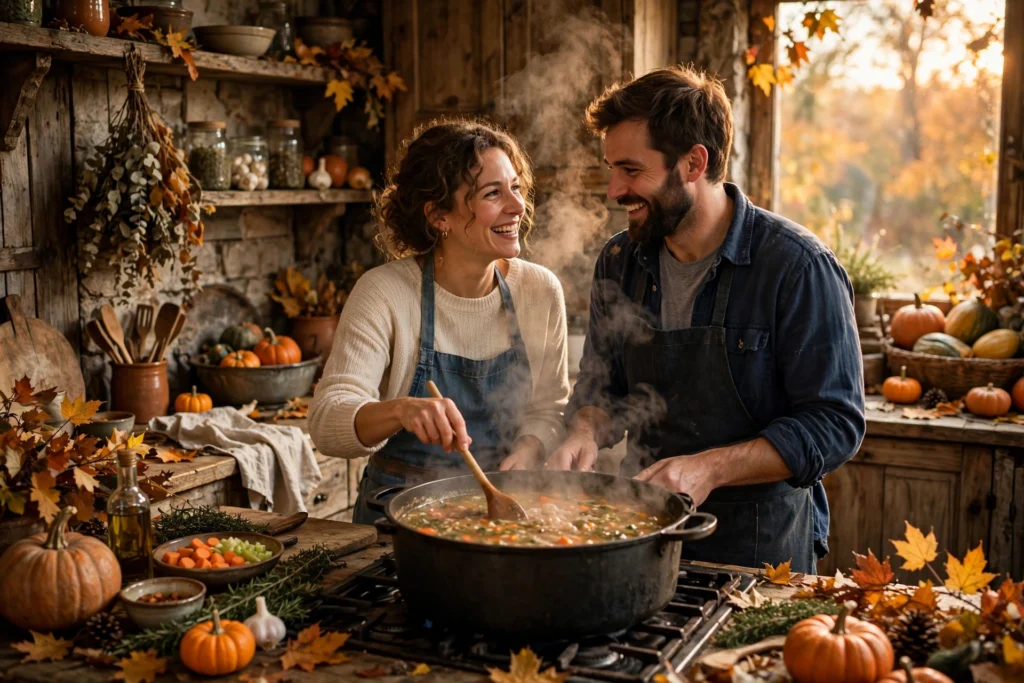
There’s a real psychological mechanism behind the cozy feeling, and it’s bigger than blankets. Studies on physical warmth show that holding something warm — a mug, a heated blanket, a partner’s hand — makes people judge others more generously and act more prosocially. Warmth primes warmth.
Autumn hands couples this effect for free. The season’s whole aesthetic is physical comfort: soup, sweaters, candlelight, the smell of something baking. Every one of those small comforts nudges both partners toward softness. You’re measurably less likely to start a petty argument when you’re both warm, fed, and comfortable than when you’re overheated, rushed, and sun-frazzled. The couples who lean into the season — actually making the soup, actually lighting the candle — are dosing their relationship with tiny hits of goodwill all evening long.
3. Darkness Lowers the Performance Pressure
Summer has a way of making relationships feel like they need an audience. There’s pressure to have the perfect beach day, the impressive vacation photos, the social calendar that proves you’re thriving. Autumn quietly retires all of that.
When it’s dark at six, nobody expects you to be doing anything. The bar drops to “be home, be warm, be together” — and most couples clear it effortlessly. That removal of performance pressure is a gift. Without the background hum of “should we be out somewhere?”, partners stop comparing their relationship to everyone else’s highlight reel and start actually enjoying each other’s company. Boring, in October, becomes a feature.
4. Seasonal Rituals Become Relationship Glue
Ask long-married couples what holds them together and they’ll rarely mention the grand gestures. They mention the small repeating things: the Sunday soup, the Friday scary movie, the walk to look at the leaves. Autumn is ritual season — it practically invents traditions for you.
Psychologists who study rituals find that couples with shared seasonal rituals report higher relationship satisfaction, and the effect strengthens with repetition. The first year you carve pumpkins together it’s cute. The fifth year, it’s yours — a private tradition no one else shares, a little proof that this relationship has a history and a future. You don’t need many. Two or three small autumn rituals, repeated yearly, do more for closeness than any single expensive date night.
5. The Contrast Effect: Gray Outside, Warm Inside
Here’s the subtlest mechanism of all. Happiness researchers talk about the power of contrast: we don’t experience comfort in absolute terms, we experience it relative to what’s around it. A warm living room feels merely nice in June. In October, with rain hitting the windows and darkness pressing against the glass, that same living room feels like a sanctuary.
Couples benefit from this contrast together. The worse the weather outside, the more precious the warmth inside feels — and your brain, not being very precise about these things, partially credits your partner for the feeling. The howling wind isn’t just weather; it’s the reason being curled up next to this person feels like the best place on earth. Autumn gives couples a free backdrop that makes ordinary togetherness feel extraordinary.
Practical Takeaways
- Protect the long evenings: treat October weeknights as bonus together-time — cook together, take a walk in the dark, or just share the couch instead of scattering to separate screens.
- Dose the coziness deliberately: warm drinks, blankets, candlelight, and comfort food aren’t just nice — they measurably nudge both of you toward generosity and patience.
- Drop the performance: let the short days retire the pressure to have an impressive social life; boring evenings at home are relationship fertilizer.
- Start two tiny rituals: one weekly (Friday movie night, Sunday soup) and one yearly (a leaf walk, pumpkin carving) — repetition is what turns cute habits into glue.
- Use the contrast: on the grayest, wettest evenings, say it out loud — “I’m glad we’re in here together” — and let autumn do the rest.