
You’re walking down the street, minding your own business, when someone across the way raises a hand and waves — big, friendly, unmistakable. Your arm shoots up before your brain has finished asking the important question: Wait… do I know that person?
You smile. You wave. You keep walking. And for the next four blocks, your mind runs a frantic background check: Was that my neighbor? A coworker? Did I just wave at a complete stranger who was actually waving at someone behind me?
We’ve all been there. The automatic wave-back is one of humanity’s most universal reflexes — and the psychology behind it is more interesting than you’d think.
Your Brain Chooses Politeness Over Accuracy
Waving back at a stranger is a split-second social calculation, and your brain is remarkably good at it. Here’s the math it does, faster than you can think: If that wave was for me and I ignore it, I look rude. If it wasn’t for me and I wave back, I look slightly silly for two seconds. The cost of ignoring a real greeting is far worse than the cost of a mistaken wave. So your brain picks the safe bet: wave first, investigate later.
This is the same logic that makes you say “you too” when the waiter says “enjoy your meal” — or answer “good, you?” to someone who said “nice to meet you.” Your social autopilot would rather be wrong and friendly than right and cold. It’s a deeply human trade-off, and honestly, it’s a lovely one.
Evolutionarily, this makes sense. For most of human history, being seen as rude or aloof could get you pushed out of the group — and getting pushed out of the group could get you eaten by something. The instinct to return every social signal, just in case, is ancient survival software. You’re not being awkward; you’re being a very good mammal.
The Awkwardness Is the Point
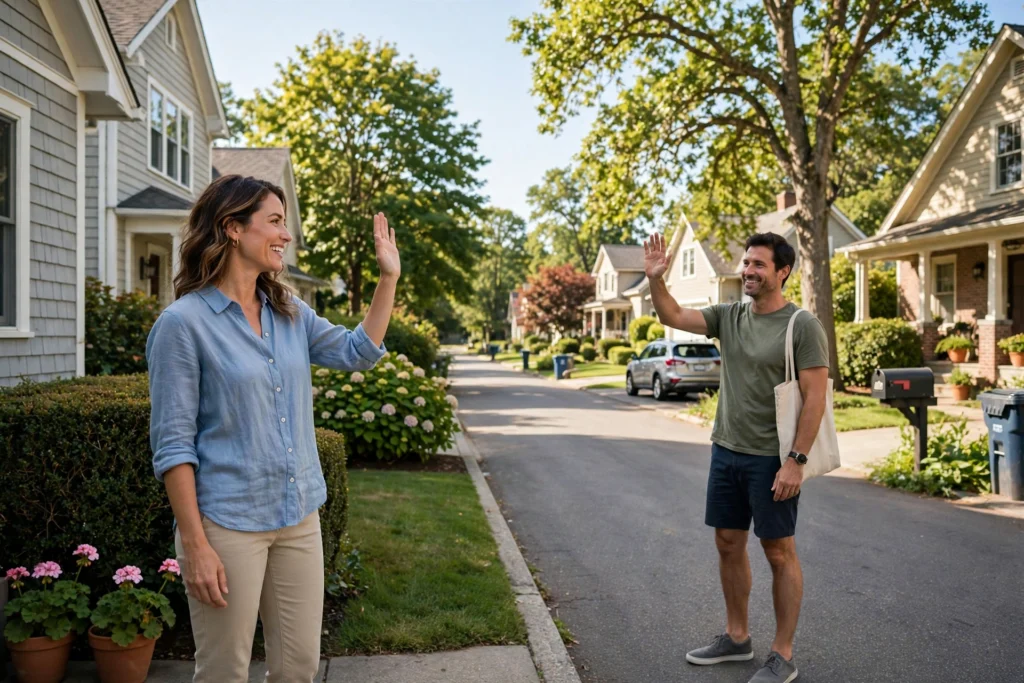
Here’s the delightful twist: the wave-back isn’t really about the other person. It’s about you. Waving back protects your self-image as a kind, friendly human. Psychologists call this “face” — the version of yourself you present to the world. Ignoring a wave (even a possibly-not-for-you wave) threatens your face. Waving back preserves it. Your arm is essentially your PR department, and it acts fast.
There’s also a fascinating bystander effect at play. If you wave back and it was for someone else, the real recipient usually waves too — and then you get a beautiful little moment where two strangers are both waving at one enthusiastic person, and everyone pretends this is normal. Nobody gets hurt. Sometimes the waver even laughs and waves at you too, because friendliness is contagious. The mistake often becomes a genuine interaction. How often does an error turn into something warmer? Almost never. Cherish this one.
The Cultures of the Wave
Not everyone waves back, of course, and that’s a curiosity in itself. In small towns, waving at strangers is practically the law — the “two-finger steering wheel wave” on country roads is a whole dialect. In big cities, the reflex gets suppressed by sheer volume; if you waved back at everyone in Manhattan, your arm would fall off by noon. Neither is ruder than the other. They’re just different social economies: when greetings are rare, each one matters more; when they’re constant, ignoring them is self-defense.
Children, wonderfully, are the best wavers of all. A toddler will wave at absolutely anyone — the mail carrier, a dog, a particularly friendly-looking mailbox. They haven’t yet learned the adult art of the calculated social risk. Watching a kid wave at strangers is a reminder of what the reflex looked like before we layered anxiety on top of it: pure, uncomplicated friendliness.
Keep Waving
So the next time your arm betrays you and waves at a stranger’s stranger, don’t cringe. You just participated in one of the cheapest, lowest-stakes kindnesses available to humans. You spent half a second of energy to avoid making anyone feel ignored. In a world that’s increasingly optimized for efficiency, the automatic wave-back is gloriously inefficient — and that’s exactly what makes it human.
And who knows? Maybe one day you’ll wave at someone, realize mid-wave that you have no idea who they are, and they’ll turn out to be an old friend whose face you’d forgotten. Stranger things have happened. Usually right after a wave.
Practical Takeaways
- Your brain waves back because the social cost of ignoring a real greeting outweighs the silliness of a mistaken wave — it’s a smart, ancient calculation.
- The reflex protects your self-image as a friendly person; your social autopilot prefers wrong-and-warm over right-and-cold.
- A mistaken wave often turns into a genuinely warm moment anyway — friendliness is contagious.
- Small towns wave more, big cities less — it’s about social economy, not rudeness. Neither is wrong.
- Kids wave at everyone without anxiety, reminding us the reflex is pure friendliness before adult overthinking gets layered on.
- Keep waving: it’s one of the cheapest, lowest-stakes kindnesses available, and the world could use more of it.